
Closing Costs in Texas, Line by Line: What Dallas–Fort Worth Buyers Pay and How to Lower Them

Closing costs in Texas come in four groups: lender fees (origination, any points, appraisal, credit report), title and escrow (title insurance, settlement fee, survey), prepaids (interest to the end of the month, the first year of homeowners insurance) and an escrow deposit for property taxes and insurance. The total varies by price, loan and date; I quote it for your file. You lower it by comparing lenders, negotiating seller or builder credits and checking your Closing Disclosure line by line.
Key takeaways
- Texas sets title insurance premiums by state rule, so the basic premium is the same at any title company. Lender fees are where offers really differ.
- Prepaid interest and the escrow deposit for taxes and insurance are not fees; they are your own money paid early, and with DFW tax rates around 2% or more they can be a big line.
- Seller concessions, builder incentives and lender credits can cover part or all of your closing costs. Each loan program has its own limits.
- You get the Loan Estimate within 3 business days of applying and the Closing Disclosure at least 3 business days before closing. Compare the two line by line.
- As a broker I shop your loan with multiple lenders, so you see more than one fee sheet before you choose.
What are closing costs, and what will I see on my paperwork?
Closing costs are everything you pay to finish the purchase beyond the down payment. Some are true fees for work someone does, like the appraisal. Others are your own money paid early, like the first months of property tax that go into your escrow account.
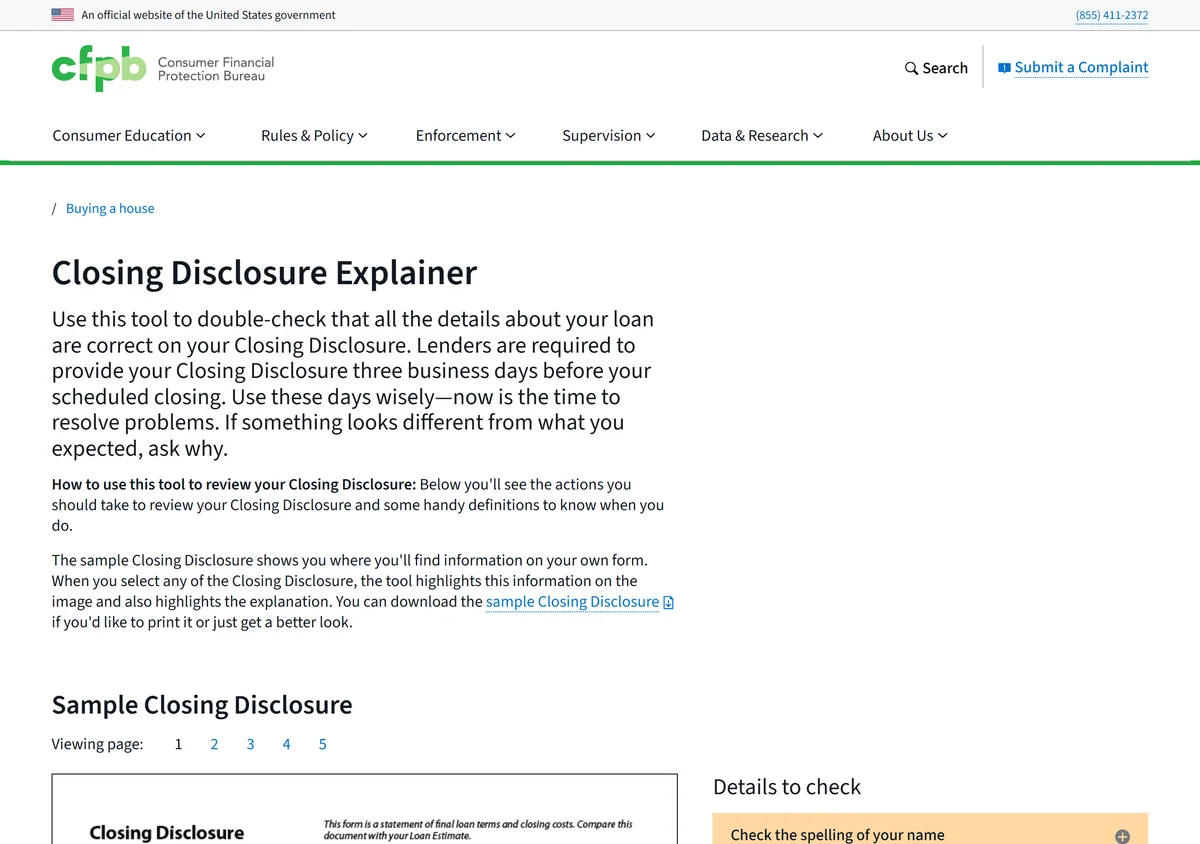
You will see the same lines twice. First on the Loan Estimate, which a lender must send within 3 business days of your application. Then on the Closing Disclosure, which you must receive at least 3 business days before closing. Both use the same sections, so you can lay them side by side:
- Section A, origination charges: what the lender charges to make the loan, plus any points.
- Sections B and C, services: appraisal, credit report, title, settlement and survey. B is what you cannot shop; C is what you can.
- Section E, taxes and government fees: mostly recording fees. Texas has no state transfer tax on a home sale.
- Sections F and G, prepaids and initial escrow: interest, homeowners insurance and the starting balance for taxes and insurance.
- Section H, other: items like an owner's title policy, HOA transfer fees or a home warranty, depending on your contract.
Whether you are buying in Flower Mound, Grapevine or Mesquite, the sections are the same. What changes is the price, the tax rate at the address, the loan program and the date you close. That is why I build every estimate from your contract, loan and closing date, not one flat number.
Which lender fees do I pay, and which can I lower?
Lender fees are where two offers for the same home differ most.
Origination charge
This is the lender's fee for processing, underwriting and funding your loan. Compare the total of Section A, not the individual names. The lender's own charges generally cannot go up after the Loan Estimate unless something real changes, like the loan amount or the program.
Discount points
Points are an upfront payment for a lower interest rate. They are optional. I show you the same loan with and without points, then we work out how many months of lower payments it takes to earn that money back. If you might sell or refinance before then, keeping the cash usually wins. On a 30-year fixed mortgage you plan to keep for a long time, points can make sense.
Appraisal
The lender orders the appraisal through an independent appraiser, so you do not pick who comes out. You often pay for it early, before closing, and it then shows as "paid before closing" on your paperwork.
Credit report
A small fee for pulling your credit, set by the lender's vendor. You cannot shop it, but it shows up in the lender comparison.
Because I am a broker, I can put several lenders' fee sheets for the same loan next to each other. A buyer looking for the mortgage company with the lowest fees in Frisco is really asking for that comparison: same rate, same lock, same loan amount, and which lender charges less to get there.
What do title insurance, escrow and a survey cost in Texas?
In Texas the title company insures the title and runs the closing.
Title insurance: the premium is set by the state
Texas is different from most states here. Title insurance premiums are set by the state through the Texas Department of Insurance, so the basic premium for the same policy on the same price is the same at every title company. There are two policies. The owner's policy protects you. The lender's policy protects the lender, and the lender requires it. Who pays for the owner's policy is a term in your purchase contract, so ask your agent before you sign it.
Escrow or settlement fee
This pays the title company to run the closing: collect funds, pay off the seller's loan, disburse money and record documents. It can vary between companies, and the contract usually says who pays it or whether it is split.
Survey
A survey shows the lot lines, the house, the fence and any easements. On a resale, the seller may already have one, and the title company may accept it if nothing has changed. If a fence or addition went in after the old survey, a new one may be needed. On new construction in Celina, Frisco or McKinney, the builder usually handles the survey; ask early so it does not become a last-week surprise.

Why do I pay interest, taxes and insurance at closing?
This part of the bill is not a fee. It is your own money, paid in advance, and it depends on the date and the address.
Prepaid interest
Mortgage interest is paid after the fact. At closing, you pay the interest from your closing day to the end of that month. Close late in the month and that line is small; close early and it is larger. I show you both if your contract allows a choice of date.
Homeowners insurance
Most lenders want the first year of the policy paid at or before closing. You control this one: get quotes early and, in North Texas, compare the wind and hail deductible, not just the premium.
Escrow deposit for property taxes and insurance
Most loans collect your property tax and insurance with each payment and pay the bills for you. At closing, the lender sets up that account with a starting balance so there is enough when the bills come due. In Texas, this is often the biggest single line, because there is no state income tax and property taxes do the work. Many DFW cities run about 2% of value a year or more, so a home in Denton or McKinney can carry a sizable tax bill.
I use the real tax rate for the address you are looking at, not a statewide guess. After you move in, file your homestead exemption with your county appraisal district; it lowers the taxable value for school taxes and can lower your escrow over time. For a first look, my payment calculator lets you enter a tax rate and insurance amount as an illustration.
Which closing costs can I shop, and which are fixed?
What the table shows
| Line item | Who sets it | Can you shop it? | How to lower it |
|---|---|---|---|
| Origination charge | The lender | Yes, by comparing lenders | Compare the total of Section A for the same rate and lock |
| Discount points | Your choice | Yes | Ask for the quote without points; pay them only if you keep the loan long enough |
| Appraisal | Appraiser chosen through the lender | No | Compare across lenders; ask when it is due |
| Credit report | Lender's vendor | No | Small; compare across lenders |
| Title insurance premium | State of Texas (TDI) | Premium is the same everywhere | Check who pays the owner's policy in your contract |
| Escrow / settlement fee | Title company | Often, through your contract | Negotiate who pays or a split with the seller |
| Survey | Surveyor | Sometimes | Ask whether the seller's existing survey can be used |
| Prepaid interest | Your closing date | Timing only | Compare closing dates if the contract allows |
| Homeowners insurance | Your insurer | Yes, fully | Get several quotes with the same coverage and deductible |
| Escrow deposit for taxes and insurance | Tax rate and bill dates | No | Not a fee; file your homestead exemption after you move in |
How to read it: the lines marked "yes" are where comparing really saves money, and lender fees are the biggest of those. The lines marked "no" or "timing only" are still worth checking on the Closing Disclosure, but shopping will not change them much.
Have a Loan Estimate from another lender? Send it over and I will tell you line by line what I can match or beat.
Book 15 minutes with CraigCan the seller, the builder or the lender pay my closing costs?
Yes, and this is where the biggest savings usually come from. Every loan program caps how much someone else can pay toward your costs, and the caps differ, so I check the limit for your loan before your agent writes the offer.
Seller concessions
A seller concession is money the seller agrees to put toward your closing costs. On one of my recent closings, a VA mixed-use purchase in Kansas City, the buyer put $0 down and the seller covered all closing costs.
Builder incentives
New subdivisions in McKinney, Frisco and Celina often come with builder incentives toward closing costs or a rate buydown, sometimes tied to the builder's own lender. Always compare that package with an outside offer. On a VA purchase I closed in Fort Worth, the builder's in-house lender could not read the buyer's active-duty and reservist pay. We could, and we secured full builder concessions; the buyer walked in with $25,000 in equity on day one.
Lender credits
A lender credit is money the lender gives you toward closing costs, usually in exchange for a slightly higher rate. I show you the payment both ways so you can decide whether keeping cash now is worth a little more each month.
Down payment assistance
Statewide programs such as TSAHC's Homes for Texas Heroes and TDHCA's My First Texas Home, plus some city and lender programs, can help with the down payment and closing costs for eligible buyers. On a recent first home in Prairie View, a program from one of my lenders covered both, with money left over to buy down the rate. My first-time home buyer guide for Dallas–Fort Worth covers these programs in more detail.
How do VA, FHA and USDA loans change closing costs?
Each government program has its own rules on fees and on who may pay them. In general terms:
- VA loans offer $0 down, no PMI and limits on the closing costs a veteran may be charged. Most VA buyers pay a funding fee, which can be financed into the loan; my calculator uses 2.15% for first use as an illustration, and some veterans are exempt. I am a Navy veteran who has used my own VA loan multiple times, so I know these lines from your side of the table.
- FHA loans start at 3.5% down and carry an upfront mortgage insurance premium that is usually financed, plus an annual premium in the payment. My calculator illustrates 1.75% upfront and 0.55% a year. In Garland and Mesquite, FHA can work for an owner-occupied duplex or small multi-family.
- USDA loans can be zero down for eligible buyers, and some outlying addresses around Denton may qualify. I check the exact address first.
- Conventional loans with less than 20% down carry private mortgage insurance, which my calculator estimates at about 0.5% a year as an illustration.
Those percentages are illustrations, not a quote; programs and terms vary by lender, so I confirm the real figures for your file. You can compare the programs side by side on my loan options page.
How do I avoid surprise fees at the closing table?
Surprise fees usually come from a lender that quoted low and added charges later, a credit never written down, or a change nobody explained. Here is how I keep them out of my files.
- Get a real Loan Estimate early. It comes within 3 business days of your application, and it is the baseline everything else is measured against. My mortgage pre-approval guide explains what to have ready.
- Know which lines are locked. Under federal rules, the lender's own charges generally cannot rise from the Loan Estimate without a valid change in your loan. Some third-party services, as a group, can only rise a limited amount. Prepaids, the escrow deposit and services you choose yourself can change with the facts.
- Put every credit in the contract. A seller or builder credit that is only promised out loud does not appear on the Closing Disclosure.
- Read the Closing Disclosure the day it arrives. You get it at least 3 business days before closing. Compare it with your latest Loan Estimate, page by page, and ask about any line that moved.
- Confirm wiring instructions by phone. Call the title company at a number you already know is real before you send money. Never trust wiring instructions that arrive by email alone.
Timing matters too. A complete file rarely runs into last-minute extension or re-lock costs. My guide on how fast you can close on a house in Dallas covers what keeps a file moving.
Why work with Craig on your closing costs?
A buyer who wants a lender that explains every mortgage fee in McKinney, or one with no surprise fees in Denton, is really asking for two things: choice and someone who answers the phone. That is how I work.
- I am a broker, not one bank. At Edge Home Finance I shop your loan with multiple lenders, so you see more than one set of fees for the same loan.
- One person from the first call to the closing table. You work with me directly, no call center and no hand-offs. I keep your agent and the title company in the loop.
- Weekly updates to you and your agent until the file is clear to close, so you hear about any change in the numbers from me first.
- Real results on closing costs: a seller who covered all closing costs, full builder concessions on a Fort Worth new build, an assistance program that covered a Prairie View buyer's down payment and closing costs, and a Brownsville VA refinance that lowered the rate with $0 out of pocket. You can read them on my recent closings page.
- Navy veteran and Naval Academy graduate, rated 5.0 from 24 client reviews from buyers, homeowners and Realtor partners.
I work across Dallas, Tarrant, Collin, Denton and Parker counties. You can see what I say about each city on my Dallas–Fort Worth cities page, and more about my background on the about Craig page. Want to see your numbers? Book a 15-minute call with no credit pull, or apply online in about ten minutes and I will send you a full closing cost estimate for your file.
Questions buyers ask Craig
How much are closing costs in Texas?
Is title insurance cheaper at one Texas title company than another?
Can I roll closing costs into my mortgage?
Do I still pay closing costs with a $0 down VA loan?
Why is my escrow deposit so large?
When do I find out the final closing costs?
Should I use the builder's lender to get closing cost help?
Educational information, not a loan offer or commitment to lend. Programs, rates and guidelines change and depend on the lender and your full file; ask Craig for current terms. Craig Scott NMLS #2650008, Edge Home Finance LLC NMLS #891464. Equal Housing Opportunity.

