How to Shop Mortgage Rates and Compare Loan Estimates in Dallas–Fort Worth

Ask at least three lenders for a quote on the same day, for the same loan amount, loan type, lock period and number of points. Once you apply, each lender must send a Loan Estimate within 3 business days. Compare the rate, Section A (the lender’s own charges, including points), Section B, cash to close and the “In 5 Years” figure on page 3. The lowest rate alone is not the best deal.
Key takeaways
- Three lenders is a good start. Quotes only compare when the day, the lock period and the points match.
- Mortgage credit checks within a 45-day window count as a single inquiry, according to the CFPB, so shop inside it.
- Section A on page 2 and the “In 5 Years” line on page 3 show the real price difference between two offers.
- A low rate with points buried in Section A, a short lock or missing fees is not a bargain.
- As a broker I can shop your loan with multiple lenders and line up the estimates for you, including the ones I would not pick.
How many lenders should I ask before buying in DFW?
Three is a good minimum. If you are buying in Mansfield or anywhere else in DFW and wondering whether to ask 3 lenders, the answer is yes. One quote tells you nothing, because you have nothing to hold it against. Two quotes tell you which is lower, but not whether either is good. With three, you start to see what a normal price looks like for your file.
Mix the kinds of lenders you ask. A bank or credit union you already use, a mortgage company, and a broker like me who can price your loan with several lenders at once. If you are buying a new build in Prosper, Celina or McKinney, the builder will usually push its own lender. Get that quote too, then get an outside offer on the same house. Builder incentives can be real money, so ask in writing which part of the incentive depends on using the builder’s lender.
How do I get mortgage quotes I can actually compare?
Most bad comparisons come from quotes that were never built the same way. Mortgage pricing moves during the week and sometimes during the day, so a quote from Monday and a quote from Thursday are not the same product. Give every lender the same scenario:
- Same loan. Same purchase price, down payment, loan amount, loan type and term. If you are weighing a 30-year fixed mortgage against a 15-year fixed, ask each lender to price both, then compare 30 to 30 and 15 to 15.
- Same day. Collect quotes as close together as you can. If one lender answers two days late, ask the others to refresh their numbers that day.
- Same lock period. A 30-day lock is usually priced better than a 60-day lock. If one quote assumes 15 days and another 45, they are not comparable.
- Same points. Ask everyone to quote with zero discount points first. If you want to see what buying the rate down costs, ask for a second quote with the same points from each lender.
- Same credit and property facts. Use your real credit score range, the property type and whether you will live in the home. A quote that guesses your credit is a guess.
Need mortgage quotes for a Carrollton house you already have under contract? Then you are past informal quotes. Apply, and ask for official Loan Estimates, because the form is the same for every lender and much harder to dress up.
Will shopping several lenders hurt my credit?
This is the fear that keeps people stuck with the first lender they called. According to the Consumer Financial Protection Bureau, multiple credit checks from mortgage lenders within a 45-day window are recorded as a single inquiry, because lenders know you are only buying one home. The individual checks can still show on your report, but they count once.
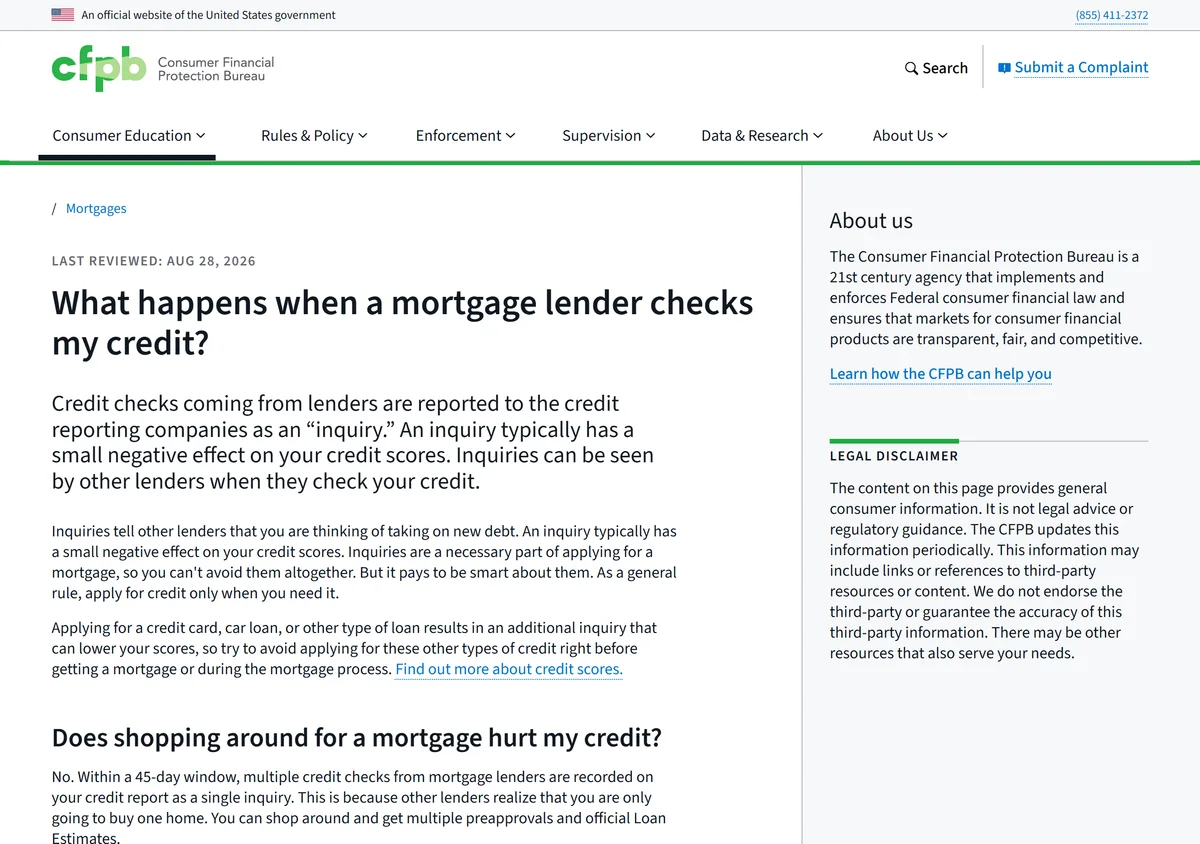
Two practical rules follow. First, do your shopping in one tight stretch, not spread over three months. Second, do not open a car loan or a new credit card while you shop. That inquiry is not grouped with the mortgage ones, and new debt changes the numbers lenders just quoted you.
You also do not need a credit pull to start. My first call is 15 minutes with no credit pull. We talk through your goals, price range and timeline, and I tell you what is realistic before anyone touches your report.
What should I check on page 1 of the Loan Estimate?
Once you apply, the lender must send a Loan Estimate within 3 business days. It is a standard three-page form set by the CFPB, so every lender’s version looks the same. That is exactly why it is the right tool for comparing. Apart from a credit report fee, a lender generally cannot charge you fees until you have the Loan Estimate and say you want to go ahead.
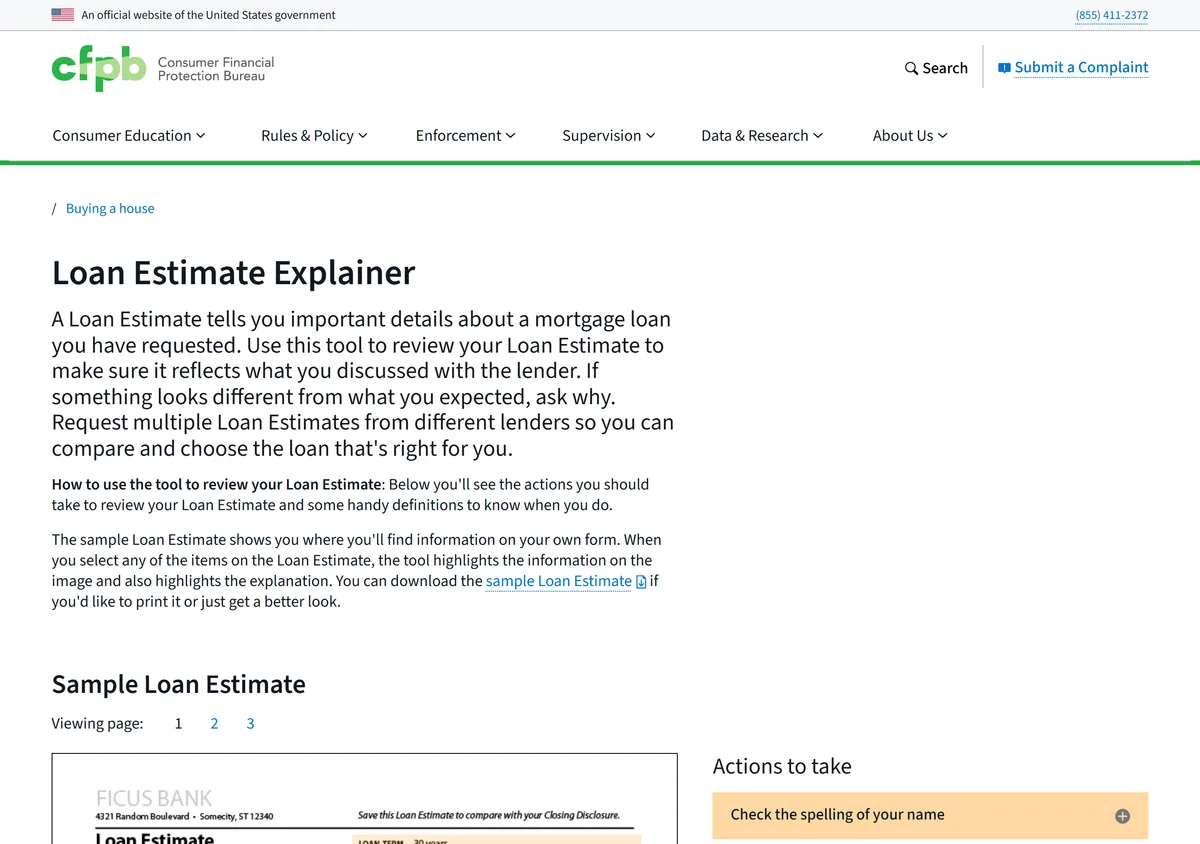
On page 1, go top to bottom:
- Rate lock box. Near the top it says whether the rate is locked, and until when. An unlocked rate on one estimate and a locked rate on another are not an even comparison.
- Loan Terms. Loan amount, interest rate and monthly principal and interest, each with a yes or no for “can this amount increase after closing?” Check the prepayment penalty and balloon payment lines too.
- Projected Payments. The estimated total monthly payment, including mortgage insurance and escrow for taxes and insurance. In DFW, property tax is the big line: many cities run about 2% of value a year or more. Make sure each lender used the same tax and insurance figures, or the payment comparison means nothing.
- Costs at Closing. Estimated closing costs and estimated cash to close. Cash to close also depends on your down payment, earnest money and any seller credit, so a lower number is not always a cheaper loan.
Where do the real differences hide on page 2?
Page 2 is where lenders actually differ. Page 1 is mostly the result; page 2 shows how they got there.
What the table shows
| Where on the form | What it shows | What to ask |
|---|---|---|
| Page 2, Section A: Origination Charges | The lender’s own fees, including discount points shown as a % of the loan amount | “How many points are in this rate, and what is the rate with zero points?” |
| Page 2, Section B: Services You Cannot Shop For | Services the lender picks, such as the appraisal and credit report | “Is anything here that the other lenders did not list?” |
| Page 2, Section C: Services You Can Shop For | Mostly title and survey costs, where you may choose the provider | “Did you use the same title figures as the other quotes?” |
| Page 2, Sections F and G: Prepaids and Initial Escrow | Insurance, prepaid interest and the tax and insurance reserves | “What tax rate and insurance premium did you assume?” |
| Page 2, Section J: Lender Credits | Money the lender puts toward your closing costs, usually for a higher rate | “What would the rate be without this credit?” |
| Page 3: Comparisons | In 5 Years, APR and Total Interest Percentage (TIP) | “Can we compare these on the same loan amount and term?” |
How to read it: compare Section A and Section B first, because those are the lender’s choices. Sections C, F and G often differ only because lenders guessed different title, tax or insurance figures, which says nothing about whose loan is cheaper.
Section A is the one I look at first on every estimate a client brings me. In general, the lender’s own charges there cannot go up at closing unless something changes, such as the loan amount or your lock. A quote with a lower rate and 1.5 points in Section A may cost you thousands more at the table than a quote with a slightly higher rate and no points. Neither is wrong. You just have to see the trade.
Points make sense when you will keep the loan long enough to earn them back. A rough check: divide the cost of the points by how much they lower your monthly principal and interest. That gives you the number of months to break even. If you plan to sell or refinance before then, the points cost you money. I build every quote around a real 3–5 year plan for the home for this reason, not just a rate.
Already have two or three Loan Estimates? Send them to me and I’ll line them up side by side. The call is 15 minutes, with no credit pull.
Book 15 minutes with CraigRate vs APR: which number tells me the real cost?
The interest rate sets your monthly principal and interest. The APR (annual percentage rate) folds the rate together with certain loan costs, like points and some fees, into one yearly figure. If two offers have the same rate but different APRs, the one with the higher APR has more fees.
APR has a weak spot: it spreads costs over the full term of the loan. Most people sell or refinance long before 30 years. That is why I like the “In 5 Years” box on page 3 more. It shows how much you will have paid in principal, interest, mortgage insurance and loan costs over five years, and how much principal you will have paid off. For two loans of the same amount and term, the one with the lower five-year total is cheaper for most buyers.
If one of your quotes is an adjustable-rate mortgage, the page 1 Projected Payments table will show more than one payment range. Look at the highest one. If you can’t live with it, the low starting rate is not a deal.
How do I know if a mortgage quote is too good to be true?
How do you know if a mortgage quote in Grand Prairie, or anywhere in DFW, is good? The quick answer: a good quote holds up when you read page 2. A lowball quote usually fails one of these tests:
- Points you didn’t ask for. The rate is low because Section A has discount points in it. Ask for the same loan at zero points.
- A short lock. The quote assumes a 15-day lock while your contract closes in 40 days. Extensions cost money, and the price you were shown disappears.
- Fees left out. Section B or C is suspiciously thin, or the taxes and insurance on page 1 are far below the others. Low escrow makes the payment look better without making the loan cheaper.
- No real file behind it. A quote over the phone with no credit check and no income review is a starting point, not an offer. Ask what credit score and income it assumed.
- A teaser structure. An ARM or a temporary buydown quoted only by its first-year payment. Ask what the full payment is after the intro period.
Sometimes one lender really does price your file better. That is the point of shopping. Just get it on a Loan Estimate, with a lock, before you count on it.
When should I lock my mortgage rate?
Lock when three things are true: you have a signed contract, you have picked the offer, and the lock period covers your closing date with a little room. Most loans close in about 21–30 days, so a lock that matches that window is common. A new build in Celina or Prosper that is still months from completion may need a longer lock, which usually costs more, or a plan to lock later. See how fast you can close on a house in Dallas to size the lock to your timeline.
Before you lock, get these answers in writing:
- The locked rate, the points or lender credits, and the expiration date.
- What an extension costs, and who pays it if closing slips because of the seller or builder.
- Whether there is any option to improve the price if rates drop before closing.
Nobody can promise where rates go next week, me included. Guessing the bottom often costs more than it saves. I would rather lock a payment you are comfortable with than chase a quarter point and lose it.
How does a mortgage broker compare lenders for me?
A bank can only offer its own menu. As a mortgage broker at Edge Home Finance, I can take your file to multiple lenders and price the same loan with each of them, on the same day, with the same lock and points. You fill out one application, online in about ten minutes, instead of three or four. Then I show you every option I compared, including the ones I don’t recommend, so you can see why.
Shopping lenders is not only about price. Sometimes it decides whether you get the loan at all. In Fort Worth, a builder’s in-house lender couldn’t read a buyer’s active-duty and reservist pay. We could, and we secured the full builder concessions: $25,000 in equity on day one. In Dallas, a buyer came to me already pre-approved elsewhere and wanted another look. We restructured the deal and got him a better one. My Realtor partner Craig Houston put it this way: his client’s previous lender could only qualify him to a certain price, and I found a lender who broke through that barrier.

Why compare your loan with Craig in DFW?
If you are looking for a cheap home loan in McKinney, a mortgage quote in Allen, or help comparing Loan Estimates in Grapevine, here is what you get from me:
- Multiple lenders, one person. You work with me from the first call to the closing table. I answer my phone, and I keep your agent and the title company in the loop.
- Every option on the table. Conventional, VA loans, FHA loans, jumbo, USDA and physician loans, priced against each other where they fit. You can browse all of my loan options.
- Weekly updates. You and your agent get an update every week until the file is clear to close.
- A 3–5 year plan, not just a rate. Points, buydowns and lender credits only make sense against how long you will keep the home.
- Someone who has sat on your side of the table. I’m a U.S. Naval Academy graduate and Navy officer veteran, and I have used my own VA loan more than once, in more than one state. More about me on my about page.
- 5.0 stars from 24 reviews. One client, Nicholas P., wrote that I helped him find the lender that best fit his needs and goals, and that he never felt rushed. You can see real loans on my recent closings page.
Before you shop, try the payment calculator to see a ballpark payment with Texas property tax included, and read the DFW mortgage pre-approval guide so your letter is ready when you find the house. Buying for the first time? The first-time home buyer guide for Dallas–Fort Worth covers the steps before the quotes. You can also see the DFW cities I work in, from Fort Worth to Frisco. Agents can see how I work with buyers on my Realtor partners page.
Ready to compare? Book 15 minutes with me, no credit pull, or apply online and I will start pricing your loan with multiple lenders.
Questions buyers ask Craig
How long does it take to get a Loan Estimate?
Can I compare Loan Estimates from different days?
Does the lowest APR always mean the cheapest loan?
Should I use the builder’s lender on a new home in Prosper or Celina?
Do I have to pay to get a Loan Estimate?
Is it worth paying points to lower my rate?
Educational information, not a loan offer or commitment to lend. Programs, rates and guidelines change and depend on the lender and your full file; ask Craig for current terms. Craig Scott NMLS #2650008, Edge Home Finance LLC NMLS #891464. Equal Housing Opportunity.